
A Shiite militia seized control of an Iraqi town for the first time Saturday, blunting the advance toward Baghdad of radical Wahhabi fighters in a sign that the widespread mobilization of paramilitary forces may be starting to have an impact.
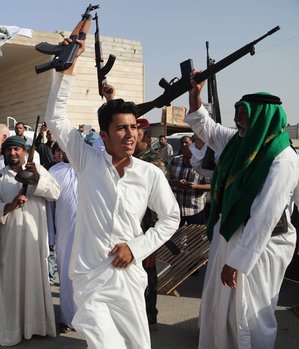
The first overtly sectarian battle of the new war unfolding for control of Iraq came as thousands of heavily armed Shiites paraded defiantly through the streets of Baghdad, responding to a call to arms from their most revered cleric.
Men young and old piled into taxis, trucks, police vehicles and minibuses and drove noisily through the streets, honking horns and waving an assortment of weapons, including rocket-propelled grenades, high-powered sniper rifles, Kalashnikov assault rifles and handguns.
"Daiish we will never surrender," chanted a group of young men piled on the back of a pickup truck, using an acronym for the al-Qaeda-inspired Islamic State of Iraq and Syria (ISIS), which carried out a stunningly swift seizure of large swaths of northern Iraq last week.
"We want to show the world that we can protect ourselves," said Khodr al-Tamimi, a turbaned cleric who waved a pistol from the window of his black, armored sport-utility vehicle as it wound through emptied shopping streets. "Wherever they go, we will defeat them," he added, referring to ISIS militants.
Iraqi soldiers and police sealed off streets and stood guard as the procession of thousands of armed men passed, a humiliating reminder of the extent to which the U.S.-trained security forces have lost stature since the mass desertions across the north that facilitated the ISIS advance.
Thousands of Shiites flocked for a third straight day to volunteer to fight, crowding recruitment centers set up in mosques, a former airport and at the homes of prominent Shiite clerics and politicians. Their numbers swelled in response to the call to jihad issued Friday by Grand Ayatollah Ali Sistani, regarded as the most influential Shiite cleric in the world. Busloads of people descended on parts of the capital from towns and cities in the south, and the travelers said more buses were on the way.
As President Obama considered military options to meet Iraq's request for assistance, Defense Secretary Chuck Hagel on Saturday ordered a U.S. aircraft carrier into the Persian Gulf.
The USS George H.W. Bush was expected to arrive in the Persian Gulf by Saturday night, along with the guided-missile cruiser USS Philippine Sea and guided-missile destroyer USS Truxtun, Rear Adm. John Kirby, the Pentagon press secretary, said in a statement.
The order to move the ships "will provide the commander-in-chief additional flexibility should military options be required to protect American lives, citizens and interests in Iraq," Kirby said.
An Iraqi general told reporters in Baghdad that the armed forces have "regained the initiative" in recent days and are now confident that Baghdad is secure.
As part of the effort to protect the capital, soldiers headed into the desert to dig a trench, according to footage broadcast on local television stations.
Maj. Gen. Qassim al-Moussawi said the military is coordinating with forces in the city of Samarra and other areas north of the capital to retake territory claimed by the insurgents "and have achieved remarkable victories with the help of volunteers."
The Iraqi security forces retreated when ISIS fighters swept into the town, repeating a pattern witnessed in numerous Iraqi towns overrun in the past week. The militia then pushed into the town from the south, forced the ISIS fighters back and took control, said a resident who spoke on the condition of anonymity out of fear for his life.
Both sides in the conflict claimed Saturday to have inflicted large numbers of casualties. The pro-government Iraqia satellite channel reported that Iraqi forces had killed more than hundreds "terrorists" across northern Iraq on Saturday.
Separately, Iran's interior minister, Abdolreza Rahmani Fazli, said that the country has "no intention of sending military forces to Iraq."
"We'll provide consultation and guidance to Iraqi forces," Fazli told reporters in Tehran, according to the semiofficial Mehr News Agency. "But if terrorists get close to our borders, we will destroy them."
Iraqi security forces claimed Saturday to have regained control of the small town of Ishaqi north of Baghdad, and claims were reported in local news media that the Iraqi air force had struck a number of targets in insurgent-occupied areas.
/129



